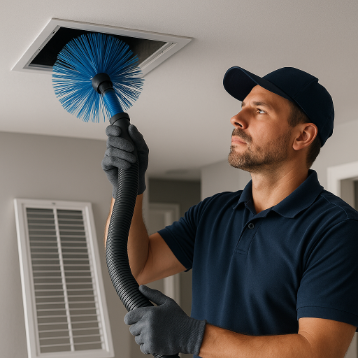
Indoor air quality rarely declines overnight. More often, it slips gradually: a fine layer of dust returning soon after cleaning, rooms that feel stuffy despite the thermostat working, or air that seems tired rather than fresh. Looking at the problem through a case-study lens helps clarify what is really happening inside a forced-air system. In many homes and light commercial spaces, dirty ductwork is not the only issue, but it can be a meaningful contributor to recirculated debris, uneven airflow, and a general drop in comfort.
The most useful way to understand professional duct cleaning is not as a dramatic before-and-after promise, but as a disciplined process. A credible assessment starts with symptoms, moves through inspection, identifies whether contamination is actually present, and then considers cleaning as one part of a broader indoor air quality strategy. That practical sequence is what turns duct cleaning from a vague service into a measurable maintenance decision.
Why indoor air quality problems are often hidden
Indoor air quality issues are easy to miss because the HVAC system is designed to operate in the background. Most of the network is concealed behind walls, ceilings, and floors, so homeowners tend to judge performance by what they can see in the living space. By the time occupants notice repeated dusting, musty odors, or reduced airflow at certain vents, the system may already be circulating accumulated debris through return and supply paths.
That does not mean every building with dust needs duct cleaning. Indoor air quality is shaped by several overlapping factors, including filtration quality, humidity control, housekeeping habits, renovation dust, pet dander, and the condition of the air handler itself. Still, when contaminants build up inside the duct system, each heating or cooling cycle can redistribute particles rather than remove them. This is why a proper diagnosis matters.
When inspection confirms substantial buildup, many property owners consider professional duct cleaning as part of a larger plan to improve system hygiene and everyday comfort. The service makes the most sense when it is connected to visible debris, post-construction residue, occupancy changes, neglected maintenance, or evidence that contaminants are being pulled and pushed through the system repeatedly.
A case-study framework: from symptoms to inspection
A useful case study does not begin with a sales pitch; it begins with observation. In real settings, the path to cleaner indoor air typically follows a sequence that reveals whether duct cleaning is warranted and what outcomes are realistic.
- Initial concerns appear. Occupants notice more airborne dust, stale smells when the system starts, or certain rooms that feel harder to heat and cool.
- The HVAC system is reviewed. Filters, registers, return grilles, blower components, and accessible sections of ductwork are checked for buildup, blockage, or signs of moisture.
- Contamination sources are identified. Dust accumulation may come from long-term neglect, remodeling work, damaged ducts, poor sealing, pet hair, or inadequate filtration.
- Cleaning scope is defined. A serious approach distinguishes between routine surface dust and deeper contamination that affects system cleanliness and airflow.
- Follow-up maintenance is planned. Cleaning alone is not enough if old filters, leaks, or humidity issues remain unresolved.
This framework helps avoid two common mistakes: assuming duct cleaning fixes every air-quality complaint, or dismissing it entirely when the system clearly contains material that should not be there. Good decisions come from inspection, not guesswork.
| Stage | What it reveals | Why it matters |
|---|---|---|
| Symptom review | Dust, odors, uneven airflow, visible vent debris | Helps connect comfort complaints to possible system issues |
| System inspection | Condition of ducts, vents, filters, and accessible HVAC components | Determines whether cleaning is justified |
| Source identification | Construction dust, pet hair, neglected maintenance, moisture concerns | Prevents the same problem from returning quickly |
| Cleaning and maintenance plan | Specific areas to address and follow-up steps | Turns a one-time service into longer-term improvement |
What professional duct cleaning actually addresses
One reason this topic is often misunderstood is that people imagine duct cleaning as little more than vacuuming a few vents. In reality, a thorough service targets the system more comprehensively. The goal is to remove settled dust and debris from the pathways that transport conditioned air, while also addressing the accessible components that influence what gets recirculated.
In practical terms, professional duct cleaning may help address:
- Built-up dust and particulate matter inside supply and return ducts
- Debris left after renovation or construction that standard housekeeping cannot reach
- Pet hair and dander accumulation in homes with multiple animals
- Material collecting around registers and grilles that repeatedly enters the airstream
- Airflow restriction caused by heavy buildup in portions of the system
What it does not do is replace filtration, repair failing equipment, or solve moisture problems on its own. If a property has active leaks, dirty coils, poor ventilation, or chronic humidity, those conditions need separate attention. The strongest case-study outcome comes when duct cleaning is integrated with broader HVAC care rather than treated as an isolated cure-all.
That distinction is important for credibility. A well-cleaned duct system can reduce the amount of debris available to circulate through living spaces, but indoor air quality still depends on everyday factors such as clean filters, proper sealing, balanced airflow, and moisture management. Results are often most noticeable in cleanliness, airflow consistency, and the general freshness of conditioned air.
What improvement looks like after cleaning
In a realistic case-study model, improvement is usually gradual but noticeable. Occupants may find that dust settles less aggressively on furniture, supply vents look cleaner, and rooms feel more consistently served by the HVAC system. In some buildings, stale startup odors become less pronounced once accumulated debris has been removed from the air pathways.
Just as important, cleaning can make routine maintenance more effective. A fresh filter performs better when it is not compensating for a heavily contaminated distribution system. Likewise, technicians inspecting the HVAC unit can assess performance more clearly when visible debris is no longer masking underlying issues. The result is not simply a cleaner duct interior, but a more manageable environment for long-term system care.
There is also a psychological dimension that should not be ignored. People tend to feel greater confidence in their indoor environment when they know the hidden parts of the system have been inspected and cleaned properly. That peace of mind is not a substitute for technical performance, but in homes where comfort and cleanliness are ongoing concerns, it is a meaningful benefit.
How to protect indoor air quality after professional duct cleaning
The most successful outcomes come after the cleaning, not during it. Once the system has been addressed, the priority should be preventing contaminants from building back up too quickly. That means treating indoor air quality as an ongoing maintenance issue rather than a one-time project.
A strong post-cleaning checklist includes:
- Replacing HVAC filters on an appropriate schedule for the home and occupancy level
- Using filter types recommended for the specific system
- Keeping supply and return vents unobstructed by furniture, rugs, or dust accumulation
- Addressing duct leaks or poor sealing that may pull contaminants from attics, basements, or crawl spaces
- Managing indoor humidity to discourage damp conditions and musty air
- Scheduling periodic HVAC inspections, especially after renovations or long periods of neglected maintenance
It is also worth paying attention to trigger events. Major remodeling, move-ins after vacancy, pest remediation, and years of deferred maintenance can all justify a closer look at the duct system. In those situations, waiting for obvious symptoms may mean living with avoidable recirculation of debris for longer than necessary.
Viewed honestly, the case for professional duct cleaning is strongest when it is based on evidence: visible contamination, persistent dust concerns, airflow issues, or known events that have compromised the system. Under those conditions, cleaning becomes a practical step toward a cleaner, more comfortable indoor environment. The most convincing transformation in indoor air quality is rarely flashy. It is the quiet improvement of a home that feels fresher, runs more consistently, and supports everyday well-being through cleaner air delivery.
To learn more, visit us on:
Precision Vac
https://www.precision-vac.com/
3039446717
Thornton, Colorado
Precision Vac is a family-owned Air Duct Cleaning company with over 10 years of experience serving the Colorado Front Range. We prioritize exceptional service, quality, and customer satisfaction, offering transparent pricing with no hidden fees. Whether you’re a homeowner or business owner, our skilled team is dedicated to exceeding your expectations because we take pride in our work and it shows in every job we complete.
NADCA Certified Technician
Quick and flexible scheduling
Knowledgeable, dependable and professional
